IGCSE revision has never had a shortage of resources. If anything, the opposite is true. Between textbooks, past papers, third-party notes and a growing number of study platforms, students now spend more time sorting through material than they do learning from it. That sorting process sits quietly at the front of every revision session, eating into the time students need most.
What has shifted in 2026 is that a more practical option now exists. AI-powered revision tools have moved from interesting experiment to genuinely useful study infrastructure — particularly for IGCSE students, where the range of exam boards, subject specifications and assessment styles creates a real need for support that is built around a specific course rather than a subject in general.
Why the exam board distinction matters more than most tools acknowledge
Cambridge IGCSE and Edexcel IGCSE are not the same course in different colours. The terminology differs. The assessment objectives differ. The weight given to specific skills — data interpretation, extended writing, structured response — varies between boards and between subjects. A student revising for Cambridge IGCSE Biology Paper 6 is preparing for a set of practical-reasoning questions that look nothing like an Edexcel IGCSE Biology Paper 2. Generic revision content flattens those differences in ways that feel acceptable on the surface but matter considerably when a student sits in front of an actual exam paper.
This is the gap that curriculum-specific AI is designed to close. When revision support is built around the learner's actual pathway — their board, their specification level, their subject — the scope and framing of what is generated reflects what the examination will actually test. Students practise recalling the right material in the right way, rather than studying an approximation of their course.
How Studiely approaches IGCSE revision differently
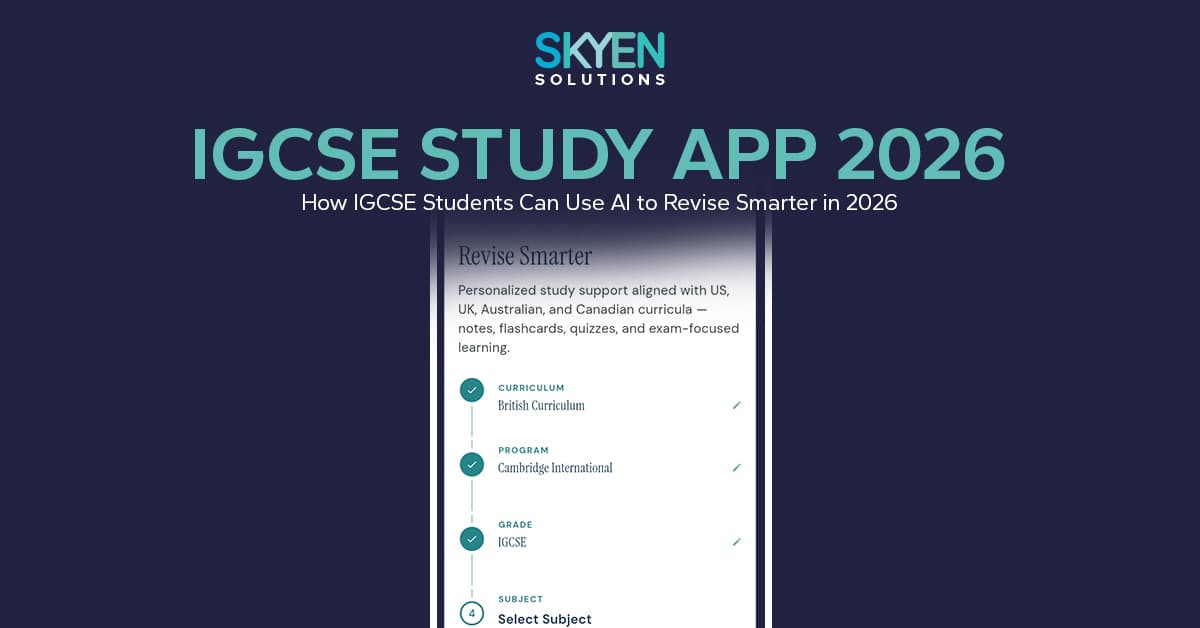
Studiely asks students to identify their curriculum system, exam board, grade level, subject and topic before it produces anything. For IGCSE students, that means selecting Cambridge or Edexcel, identifying the subject, and specifying the topic. That starting sequence is not a cosmetic choice — it shapes everything the platform generates from that point forward.
Summary Notes gives students a structured foundation for any IGCSE topic. Rather than reading through a chapter and extracting the relevant parts, a student selects their topic and receives notes shaped to their route. For subjects like Chemistry, History and Geography, where the scope can feel overwhelming and the specification-relevant content easy to miss, this starting point saves meaningful revision time.
Flashcards builds on those notes through active recall. The cognitive science behind spaced repetition is well-established: retrieving information from memory, rather than re-reading it, produces stronger and more durable learning. Studiely's flashcard feature gives IGCSE students a way to apply that method without having to construct a system manually. The deck is generated, aligned to the course, and ready to use.
Quiz takes students a step further. Reading notes creates a surface familiarity with material that can be mistaken for genuine understanding. Answering questions under low pressure exposes the gaps before they appear in an examination — which is the only setting where those gaps are expensive.
Exam Practice moves revision into more demanding territory when students are ready for it. For IGCSE students working toward their May and June sessions, this is where studying shifts from reviewing material to genuine exam-readiness.
The practical difference in a revision session
The change is not primarily about speed, though that is real. A student who can generate structured notes in under a minute and move directly into flashcard practice has significantly more usable revision time per session. The more consequential shift is consistency. Revision breaks down most often not because students lack time, but because the entry point into study feels unclear and the process feels scattered.
AI tools remove a number of the friction points that create that scatteredness. A student does not have to build materials from scratch. They do not have to check whether their notes align with their specific exam board. They do not have to manage four separate platforms to move through a complete revision cycle. That reduction in setup cost makes it easier to start — and for many students, starting is where revision most reliably falls apart.
For IGCSE students specifically, this matters because the exam season compresses quickly. May and June arrive faster than September feels, and revision that begins late, progresses inefficiently or relies on mismatched materials puts unnecessary pressure on a period that is already demanding.
A note on where Studiely fits alongside other revision tools
Studiely is not a replacement for school lessons, teacher guidance or past paper practice. It is a tool that sits alongside those things and handles some of the structural work that revision requires. A student who uses Studiely to generate notes and flashcards immediately after a lesson, then returns to Quiz later in the week and Exam Practice in the final run-up to their papers, is applying a spaced, active revision rhythm — the kind that cognitive science consistently shows to be more effective than cramming.
That kind of revision is not difficult to build. But it does require an entry point that is easy enough to use that students actually use it. Studiely is designed to be that entry point for IGCSE students across Cambridge and Edexcel routes.
One advantage of AI revision tools that students rarely anticipate is how they change the return visits to a difficult topic. Because Studiely generates output each time a selection is made, a student who revisits organic chemistry mechanisms or market equilibrium models receives slightly different examples and phrasing. That variation, minor as it seems, is precisely what cognitive researchers describe as desirable difficulty — the kind of slight friction in retrieval that makes long-term retention more robust. For IGCSE students working across multiple science or humanities subjects simultaneously, that quiet benefit compounds meaningfully over a full revision cycle. IGCSE students can start free at studiely.com.