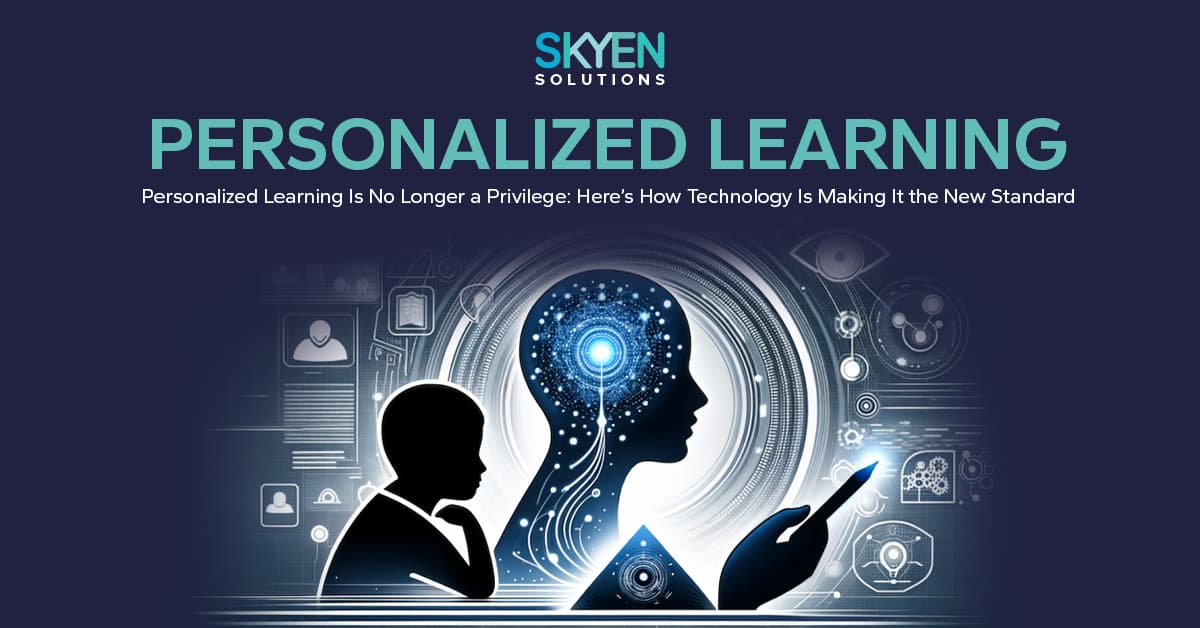
For most of the history of formal education, personalized learning was reserved for the privileged few.
Private tutors. Small class sizes. One-on-one coaching. The students whose learning was genuinely tailored to their pace, their gaps, and their strengths were the ones whose families could afford the access. The remaining majority went through a system built around the mythical average student, moving at a pace that was too fast for some, too slow for others, and genuinely right for very few.
That era is ending. AI-powered adaptive learning has made personalized education scalable for the first time in history, not just for students who can pay for premium instruction, but for anyone with a smartphone and the drive to learn. The question for schools, educators, and students across America is no longer whether personalized learning is possible. It is whether you are building it into your approach.
Skyen Solutions was built around this shift. Every platform in our ecosystem is a direct application of personalized, student-centered learning principles, made practical, accessible, and genuinely effective through technology. Here is what that actually means, and why it matters for every learner and educator in the United States today.
What Personalized Learning Actually Means Beyond the Buzzword
“Personalized learning” has become one of the most overused terms in modern education. Every edtech product claims to offer it. Every school reform initiative promises it. The word has been used so broadly that it has started to lose the precision that makes it meaningful.
Genuine personalized learning has three non-negotiable characteristics. It adapts to where the individual learner actually is, not where the curriculum assumes they should be. It adjusts the pace and depth of instruction based on real performance data, not arbitrary timelines. And it continuously responds to change, accelerating where a learner is thriving, slowing down and reinforcing where they are struggling.
By that definition, giving every student access to the same digital content is not personalized learning. Tracking which lessons a student has completed is not personalized learning. Adding a student’s name to a dashboard is definitely not personalized learning.
True personalized learning changes what content a student sees, when they see it, how challenging it is, and in what format, based on what that specific learner needs at that specific moment. That is what the Skyen platforms are designed to deliver.
The Science That Makes Adaptive Learning Work
Adaptive learning is the technological implementation of personalized learning, and its effectiveness is rooted in well-established learning science.
The core principle is the Zone of Proximal Development, a concept introduced by psychologist Lev Vygotsky that describes the sweet spot between what a learner can do independently and what they cannot yet do at all. Learning is most efficient, and most durable, when it operates in this zone: challenging enough to demand effort, accessible enough to make progress possible.
A traditional classroom cannot keep every student in this zone simultaneously. When a teacher pitches a lesson at the middle of the class, the students above that level are understimulated and the students below it are lost. The teacher has no practical alternative because there are thirty students and one instructor.
Adaptive learning technology can keep every student in their individual zone simultaneously because it is not constrained by the limitations of a single human teaching a group. It analyzes each learner’s responses, identifies their current developmental edge, and continuously calibrates content to maintain optimal challenge. This is not a promise for the future. It is what well-built AI-powered platforms are already doing.
Student-Centered Learning: What It Looks Like When Technology Does It Right
Student-centered learning shifts the focal point of education from what the teacher delivers to what the student actually experiences and retains. It is not a rejection of the teacher’s role. It is a reorientation of where the educational process is designed to land.
In a genuinely student-centered learning environment, several things become possible that a teacher-centered model cannot deliver:
A student who already understands a concept does not have to sit through repeated instruction of it. They move forward. Their time goes to the next challenge, not to waiting for the class to catch up.
A student who is struggling with a concept gets more exposure, more practice, and more varied presentations of it, not a single explanation delivered once at the pace of the group.
Progress is measured against each student’s own growth trajectory, not against a single benchmark that advantages some and disadvantages others.
Students develop greater ownership of their learning because the system responds to them. It is not indifferent to their individual performance the way a fixed curriculum is.
This is the experience the Skyen Solutions platforms are built to create, for students studying independently, for teachers building instruction, and for test-takers pursuing specific language goals.
How Skyen’s Platforms Put Personalized Learning Into Practice
Each platform in the Skyen Solutions ecosystem applies personalized, adaptive learning principles to a specific educational context.
Studiely: Personalized Study, Powered by AI
Studiely is an AI-powered study app that transforms a student’s own course material into an adaptive flashcard system. Rather than delivering the same study content to every user, Studiely tracks individual performance across every card in a deck, identifying which concepts are mastered, which are emerging, and which are still weak.
Study sessions are automatically weighted toward the areas where each student needs the most work, and content is re-introduced at scientifically optimal intervals using spaced repetition. Every study session is different because every student’s knowledge state is different.
Make My Lesson: Personalized Instruction Planning for Every Classroom
Make My Lesson brings personalized learning to the teacher’s side of the equation. Its AI lesson planning system generates complete instructional plans tailored to specific subjects, grade levels, learning objectives, and student diversity needs.
A teacher serving a class with ELL students, diverse learning profiles, and wide achievement ranges can generate differentiated materials that address those specific realities, not a generic plan designed for a hypothetical average class. Personalized learning starts with personalized planning.
Linguatude: Adaptive Language Learning for Standardized Test Success
Linguatude builds personalized study plans for learners preparing for standardized English tests including IELTS and PTE Academic. Starting from a diagnostic assessment of each learner’s current proficiency across all four language skills, Linguatude maps a preparation pathway tailored to their specific gaps and target score.
As learners progress, the plan adapts, redirecting effort toward areas that still need development and maintaining mastered skills without over-drilling them.
Why Personalized Learning Is No Longer Optional for American Students
The United States is one of the most educationally diverse countries in the world. American classrooms contain students from different linguistic backgrounds, different prior educational experiences, different socioeconomic contexts, and widely varying learning needs. The single-pace, single-delivery model of traditional instruction is not just inefficient in this environment. It is actively inequitable.
Personalized learning technology does not solve every equity challenge in American education. But it does something that was previously impossible: it gives every learner, regardless of their starting point, a study and instructional experience that is built around where they actually are. That democratization of individualized instruction is one of the most significant things AI has made possible in education.
The students who were best served by traditional education were those whose prior preparation, learning style, and pace happened to match what the system was designed for. Everyone else was asked to adapt to a system that was not adapting to them. That is a solvable problem, and Skyen Solutions is solving it.
The Future Belongs to Learners Who Learn on Their Own Terms
Personalized learning is not a feature. It is a philosophy, and it is one that the best educational technology now makes available to every student, every teacher, and every test-taker who is willing to use it.
The days when a one-size-fits-all curriculum was the only option are genuinely behind us. The tools exist. The science is clear. The only question is whether you are ready to build a learning experience that works for you, not for the average student the system was designed around.
Skyen Solutions builds those tools. Explore our platforms and take the first step toward learning that finally fits.