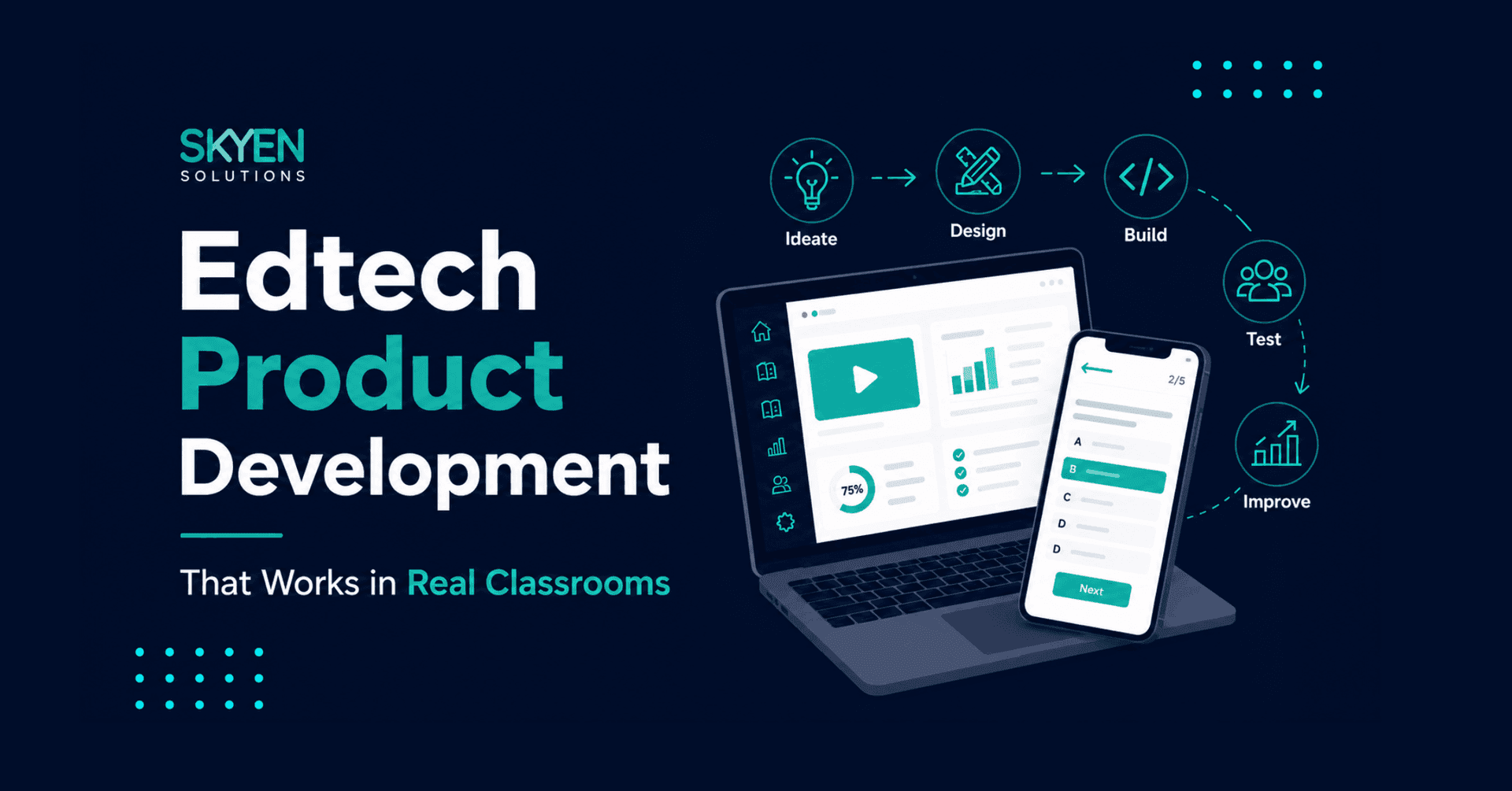
Edtech product development is one of the most technically demanding and pedagogically complex challenges in the software industry. Building a product that works in real educational environments — where users include eight-year-olds, undergraduate students, overwhelmed teachers, and English language learners sitting high-stakes immigration tests — requires a level of user understanding that goes significantly beyond standard product design principles. Yet the edtech sector continues to produce tools that are technically functional but instructionally irrelevant: products that look impressive in a pitch deck and go unused in the classroom within six weeks of deployment.
The failure rate in edtech is not a technology problem. The majority of failed education technology products were technically sound. They failed because the teams building them did not understand learning science, did not consult the educators who would use them, or built digital versions of paper processes without asking whether the paper process was worth digitising in the first place. Successful education app development starts with a question that is deceptively simple and rarely asked rigorously: what is the specific learning problem this product solves, and does the digital format solve it better than the alternatives?
This blog examines what separates edtech products that earn lasting adoption from those that do not — the principles behind serious learning platform development, the common failure points, and what a thoughtful digital education product actually looks like when it is designed around how people learn rather than how technology works.
The Difference Between Digitising Education and Improving It
The first generation of large-scale edtech products largely digitised existing educational formats. Digital textbooks replaced print textbooks. Online versions of worksheets replaced paper worksheets. Video lectures replaced in-person lectures, then sat largely unwatched. The digitisation was real, but the educational improvement was minimal because the underlying instructional design had not changed. A passive reading experience is a passive reading experience whether it happens on paper or a screen.
Second-generation education app development has been more sophisticated. The tools that have demonstrated genuine educational impact share a common design philosophy: they use the specific capabilities of digital technology — adaptivity, immediate feedback, data tracking, personalisation at scale — to do things that paper and in-person instruction cannot do easily. Adaptive learning platforms that adjust question difficulty in real time based on student performance. Spaced repetition tools that surface the right content at the right interval to interrupt forgetting. Diagnostic assessments that identify individual learner gaps and build personalised study plans automatically.
These are not digitised versions of old processes. They are learning platform development projects built around the mechanisms of learning — retrieval practice, spaced repetition, formative feedback, scaffolded instruction — and designed so that digital technology genuinely amplifies those mechanisms rather than just housing them.
The Core Principles Behind Successful Education App Development
Learning science must inform product architecture, not just marketing copy. An edtech product that references 'personalised learning' or 'adaptive technology' in its positioning but delivers a static content library with a progress bar is not a learning product — it is a content library with a user interface. Genuine edtech product development requires the team to engage with research on how memory works, how skills are acquired, and what instructional conditions produce durable learning. The Ebbinghaus forgetting curve, retrieval practice research, and cognitive load theory are not academic curiosities — they are design specifications for a serious digital education product.
Teacher and student input must shape the product from the earliest stages. The most common failure mode in education app development is building a product for a user the development team imagines rather than the user that actually exists. A secondary school teacher preparing thirty different lesson plans each week has completely different needs from the teacher a product team pictures in their user research sessions. Ethnographic research in real classrooms, sustained feedback loops with actual teachers and students, and iterative testing in genuine educational settings are not optional steps — they are the core of responsible learning platform development.
Curriculum alignment is a non-negotiable feature, not an add-on. Educational technology products that cannot demonstrate alignment to the standards teachers are required to teach will not survive procurement decisions in US schools. Common Core, NGSS, TEKS, and state-specific standards frameworks define the instructional landscape that teachers operate within. A digital education product that ignores these frameworks forces teachers to do additional mapping work to use the tool — and most teachers will simply choose not to.
Why Most Edtech Products Fail to Achieve Adoption
The research on edtech adoption consistently identifies three primary failure points: complexity that exceeds a teacher's available time, lack of demonstrated learning impact, and misalignment with existing classroom workflows. A tool that requires forty-five minutes of setup before a student can use it will not be used. A tool that cannot show a teacher why it is improving their students' learning will not sustain engagement past the initial curiosity period. And a tool that asks teachers to fundamentally restructure how they run their classroom in order to accommodate the product's requirements will be deprioritised the moment the school year's competing demands intensify.
Successful learning platform development avoids these failure points by designing for the teacher's actual workflow rather than an idealised version of it. This means minimal onboarding friction, immediate and interpretable data on student performance, and integration with the curriculum frameworks and lesson planning processes that already exist in the classroom. A digital education product that fits into how teachers already work — rather than demanding they change how they work to accommodate the product — has a dramatically higher adoption ceiling.
How Skyen Solutions Approaches Edtech Product Development
Skyen Solutions is a digital education platform ecosystem built around the principle that different learners need purpose-built tools, not generalised platforms stretched to cover every use case. Rather than building a single product that claims to serve students, teachers, and test-takers equally, Skyen developed three specialist platforms: Studiely, which generates adaptive flashcard and quiz decks from students' own notes using active recall and spaced repetition; Make My Lesson, which produces complete, curriculum-aligned lesson plans, worksheets, and assessments for teachers in minutes; and Linguatude, which delivers personalised, diagnostic-first preparation for English proficiency examinations including IELTS, PTE Academic, and TOEFL iBT.
Each platform was built around the specific needs of its target user — the student who needs retrieval practice tools, the teacher who needs planning infrastructure, the test-taker who needs a structured preparation pathway — rather than attempting to serve all three with the same product architecture. This is the approach that serious edtech product development demands: deep understanding of the specific user's specific problem, followed by disciplined product design that solves that problem rather than demonstrating technical capability. Skyen's model reflects what the edtech sector has learned through a decade of adoption failures: specialist tools, built around learning science, adopted into real workflows, outperform generalist platforms every time.
Frequently Asked Questions
What is edtech product development?
Edtech product development is the process of designing, building, and iterating on digital tools and platforms intended to support learning, teaching, or educational administration. It differs from standard software product development because it requires deep engagement with learning science, curriculum frameworks, and the specific workflows of educators and learners. The most effective edtech products are not simply digitised versions of existing educational resources but tools designed to leverage the specific capabilities of digital technology — adaptivity, personalisation, immediate feedback — to do things that traditional instruction cannot easily achieve.
What are the most common reasons education app development fails?
The most common failure points are insufficient engagement with actual users during development, lack of curriculum alignment, complexity that exceeds a teacher's available time, and absence of clear evidence of learning impact. Products built for an imagined user — rather than the actual teacher or student who will use them — tend to fail at adoption even when they are technically strong. The second most common failure is building a digital version of an existing process without asking whether the process needed to exist at all.
What makes a digital education product genuinely effective?
Genuinely effective digital education products are built around the mechanisms of learning rather than the mechanics of technology. They incorporate research-backed principles — retrieval practice, spaced repetition, formative feedback, scaffolded instruction — and use digital capabilities to implement those principles more effectively than traditional formats can. They align to the curriculum frameworks teachers are required to use, they fit into existing classroom workflows rather than demanding restructuring, and they provide teachers with clear, interpretable data on student progress.
How does learning science inform edtech product development?
Learning science provides the foundational design specifications for serious edtech products. Research on the Ebbinghaus forgetting curve informs how spaced repetition systems are built. Retrieval practice research shapes how quiz and practice tools surface content. Cognitive load theory influences how interfaces are designed to avoid overwhelming users with information. Formative assessment research defines what feedback mechanisms should look like. Teams that treat learning science as a marketing frame rather than a design framework produce products that look educational but do not improve learning.
What is Skyen Solutions and how does it approach edtech development?
Skyen Solutions is a digital education ecosystem comprising three specialist platforms — Studiely for student-led retrieval practice, Make My Lesson for teacher lesson planning and curriculum resource generation, and Linguatude for standardised English proficiency exam preparation. Skyen's approach to edtech product development is rooted in the belief that different educational users need purpose-built tools rather than generalised platforms. Each platform is designed specifically for its target user's workflow and learning needs, with curriculum alignment, learning science, and real-world usability built into the product architecture from the start.