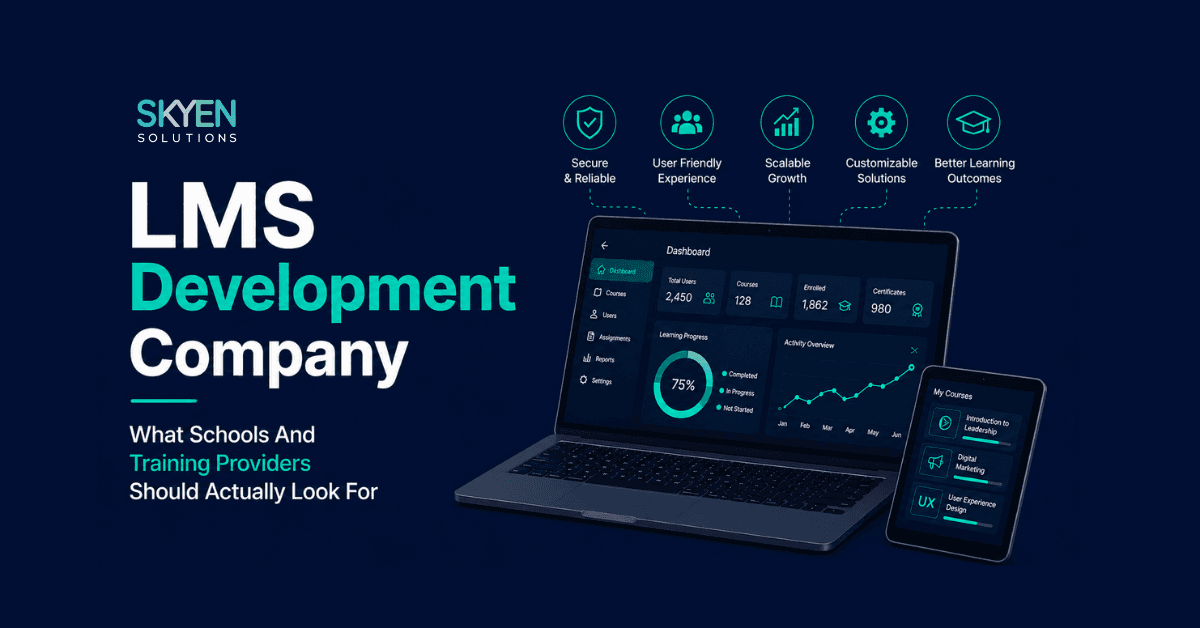
An LMS development company builds custom learning management systems that centralise course content, track learner progress, and support assessment, tailored to a specific institution's structure rather than forcing a generic template. The right partner understands both the technical architecture and the pedagogical requirements that make an LMS genuinely usable.
Choosing between an off-the-shelf learning management system and a custom build is one of the most consequential decisions an education provider makes. An LMS development company builds a platform specifically around your institution's curriculum structure, reporting needs, and user experience — rather than forcing your processes to fit a generic template built for a different market. At Skyen Solutions, we've built learning management systems for schools and training providers, and the clearest pattern we see is this: institutions with genuinely unique workflows benefit enormously from a custom build, while simpler needs are sometimes served well enough by existing platforms.
This guide explains what a strong LMS actually needs to deliver, when custom development makes more sense than an existing platform, and the technical decisions that shape long-term success.
What a Genuinely Effective Learning Management System Delivers
An online learning platform needs to do more than host content. It should structure courses around clear learning objectives, track individual and cohort-level progress, and give instructors clear visibility into where learners are struggling.
Assessment integration matters enormously. A strong education portal development project builds quizzes, assignments, and grading directly into the core system, rather than requiring instructors to manage assessment through separate, disconnected tools.
Reporting capability often gets underestimated during planning, but it's frequently the feature institutions rely on most once the system launches — accreditation bodies, boards, and management all typically need clear, exportable progress data.
When Custom LMS Development Makes Sense Over Existing Platforms
Institutions with highly specific curriculum structures, compliance requirements, or reporting formats often find that existing platforms force awkward workarounds that a custom-built system avoids entirely.
Integration needs are another strong signal. If your institution needs the LMS to connect directly with a student information system, a specific assessment tool, or an existing internal database, custom development often proves more reliable than trying to bolt together multiple third-party platforms.
Scale also matters. Larger institutions or those planning significant growth benefit from architecture built specifically for their trajectory, rather than hitting the licensing or performance limits of a generic platform down the line.
Technical Architecture Behind a Reliable LMS
Modern learning management systems are typically built as web applications using frameworks like React or Vue for the front end, paired with Node.js, Python, or .NET for back-end logic and data processing.
Database design needs to handle complex relationships between courses, learners, assessments, and progress records reliably at scale. Relational databases like PostgreSQL are commonly used for this structured, interconnected data.
Video and content delivery infrastructure also deserves early planning attention, since course content often includes large media files that need to load reliably for users across varying internet connections and devices.
Security and Data Privacy Considerations
Education portal development projects handle sensitive learner data, particularly for younger students, making role-based access control and data encryption non-negotiable requirements from the earliest architecture decisions.
Compliance with Australian education data privacy standards needs to be built into the system design, not treated as a checklist item added after development is largely complete.
Regular security auditing becomes increasingly important as an LMS scales, since a system serving thousands of learners represents a significantly larger target than a small pilot deployment.
Choosing the Right LMS Development Partner
Look for a development partner who understands both the technical requirements and the pedagogical context of how the system will actually be used by instructors and learners day to day.
Ask specifically about post-launch support and how the system handles updates to curriculum structure or assessment formats over time, since education requirements evolve and the LMS needs to adapt without requiring a full rebuild.
At Skyen Solutions, we work closely with schools and training providers to build learning management systems around genuine curriculum and reporting needs, ensuring the final platform fits how education actually happens at your institution.
Final Thoughts
A custom-built learning management system gives institutions with specific curriculum, integration, or scale requirements a platform genuinely designed around their needs, rather than a generic tool requiring constant workarounds. The right LMS development company treats both the technical and pedagogical dimensions as equally important from the start.
Considering a custom learning management system for your institution? Contact Skyen Solutions today for a free consultation, and let's map out whether a custom LMS is the right fit for your needs.
Frequently Asked Questions
How much does custom LMS development cost?
Costs vary significantly by scope, but most custom LMS development company projects in Australia range from $50,000 to $200,000+, depending on features, integrations, and scale requirements.
When does a custom LMS make more sense than an existing platform?
Custom development makes sense when an institution has specific curriculum structures, integration needs, or compliance requirements that existing online learning platforms can't accommodate without significant workarounds.
How long does it take to build a custom learning management system?
Most education portal development projects take five to nine months, depending on complexity, required integrations, and the extent of assessment and reporting features needed.
Is student data safe on a custom-built LMS?
Yes, when the system is built with proper role-based access controls, encryption, and compliance with Australian education data privacy standards from the initial architecture stage.
Can a custom LMS integrate with our existing student information system?
Yes, this is one of the main advantages of custom LMS development, since the system can be built specifically to connect with your existing internal tools and databases.